
Where to start
A small amount of crusting in the corner of the eye is normal, PDSA says; continual weeping or a sticky discharge is not. None of the vet and charity pages we read gives brown a meaning of its own. Green or yellow usually means bacteria are involved, International Cat Care says. Wipe a dry crust away with damp cotton wool. If it keeps coming back, or your cat squints or rubs the eye, call the vet.
Is cat eye discharge normal?
A little of it is. Cats make tears all the time to protect their eyes, International Cat Care says, and PDSA calls a small amount of crusting in the corner of the eyes normal. That’s the dry speck you pick off in the morning.
The line is how much there is and how wet it is. PDSA says continual weeping or a sticky discharge is not normal. International Cat Care puts it as excessive tears or a thicker, mucous-type discharge, and says either can be a sign that something’s wrong.
A healthy eye, in International Cat Care’s words, is clear, bright and free of discharge or inflammation. Most cats don’t need their eyes cleaned: it says you generally shouldn’t need to, unless your cat has a very flat face, like a Persian.
Cat eye discharge brown: what it can mean
None of the vet and charity pages behind this guide gives brown a meaning of its own. What they describe is the crust, how wet it is, and the eye around it.
A crust can start out wet. With conjunctivitis, International Cat Care says, the discharge from the eyes may dry to form a crust.
Thick and dark is another matter. Cornell Feline Health Center says that with conjunctivitis the discharge, depending on the cause, can be either colourless and watery or thick and dark-coloured. Conjunctivitis is an inflammation of the thin lining inside the eyelids and over the eyeball, and Cornell calls it the most common of all feline eye disorders.
A mark on the fur below the eye can be staining from tears. When tears overflow, International Cat Care says, you may see staining on your cat’s face. The most common reason for the overflow is a blocked tear duct.
So judge the eye, not the shade. A dry speck in the corner of a bright, open eye is PDSA’s normal crust. A sticky, wet or thick discharge that keeps coming back, whatever its colour, is a reason to call the vet.
Cat eye discharge colour meaning: clear, yellow, green
Colour is a clue. It doesn’t name the cause on its own. International Cat Care says a green or yellow discharge usually means there’s a bacterial infection involved.
Discharge can change colour as an infection goes on. With chlamydia, a bacterium passed between cats through eye secretions, Cornell Feline Health Center describes discharge that is clear at first, then contains mucus and looks yellowish and pus-like.
Runny eyes have causes that aren’t infections at all. International Cat Care names allergies to pollen, dust, mould, chemicals or certain foods, and says other signs can include sneezing, itchiness and red skin. Cats Protection lists irritants such as perfumes, dust and cleaning chemicals, and PDSA adds smoke, dust, sand or acid.
Blood is different. PDSA lists blood in the eye among the signs of an eye problem, along with cloudiness, a bulging eye and a change in the size or shape of the pupil. Any of these goes to the vet.
Cat eye discharge in one eye
One eye doesn’t narrow it down much. PDSA and Cornell Feline Health Center both say conjunctivitis can affect one eye or both.
Look for a reason on that side. PDSA’s list for conjunctivitis includes something stuck in the eye, such as a grass seed or another cat’s claw, and eye ulcers, which are scratches or abrasions on the front of the eye. Cats Protection names injuries from getting something stuck or fighting.
Then look at the eye itself. International Cat Care suggests a well-lit room, checking for discharge, swelling, redness, the third eyelid showing, and any cloudiness. The third eyelid sits in the inside corner of the eye, PDSA says, beneath the outer lids. Compare with the other eye, which shows you what normal looks like on your own cat.
Watch what your cat does with it. Cats Protection’s signs include squinting with one or both eyes, even when it isn’t bright, and scratching and rubbing one or both eyes more than usual. PDSA reads holding the eyes closed, squinting and rubbing as pain.
Eye discharge and sneezing: cat flu
Runny eyes can be a sign of an upper respiratory infection, better known as cat flu. In over 90% of cases, International Cat Care says, it’s caused by feline calicivirus or feline herpesvirus, and both can cause discharge from the eyes and conjunctivitis.
International Cat Care lists its typical signs: sneezing, discharge from the nose and eyes, red eyes and frequent blinking, lethargy, loss of appetite and a high temperature. Herpesvirus tends to be more severe, often with marked conjunctivitis and ulcers on the surface of the eye.
It can come back. Cornell Feline Health Center says cats carry herpesvirus for life once infected, and may have recurring bouts of upper respiratory and eye disease. These flare-ups are often fairly mild and clear up on their own, though in rare cases, Cornell says, the infection can lead to more serious illness, and even death in cats with other health problems. Up to 45% of the cats who carry it shed the virus now and then, usually when stressed.
At home, Cats Protection suggests keeping your cat warm with peace and quiet and a cosy bed, gently wiping away eye or nose discharge with damp cotton wool, and warming their food a little or offering something strong-smelling, like sardines. International Cat Care explains why food is hard: cats with flu have a poor sense of smell, and eating may be uncomfortable.
Cat flu is highly contagious between cats, Cats Protection says, though people can’t catch it. If you have more than one cat, wash the bedding and bowls the poorly one uses thoroughly. Kittens are more vulnerable and can develop severe signs, such as pneumonia and eye ulcers. Vaccination won’t stop a cat catching cat flu, Cats Protection says, but it’s the easiest way to stop them getting severe cat flu. If you notice these signs, contact your vet.
How to clean your cat’s eyes
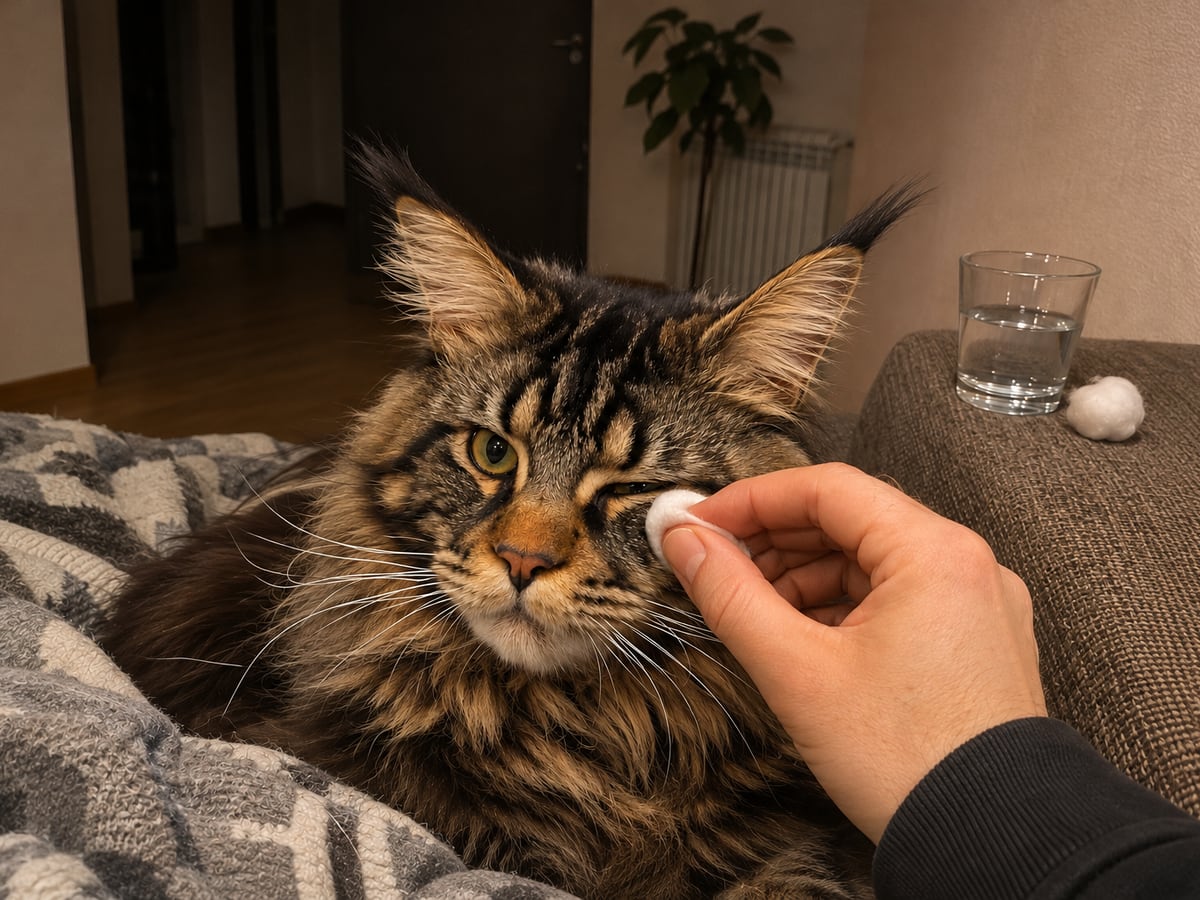
You need cotton wool and clean water. International Cat Care’s way: dampen a cotton wool ball with clean water and gently wipe around the eye, from the corner outwards. Use a separate ball for each eye, then dry with a soft tissue.
Keep off the eyeball. International Cat Care says touching it will be painful, and your cat will try to avoid the experience in future.
PDSA uses cotton wool pads dipped in lukewarm water, and says never to use a wipe that isn’t meant for a cat’s eyes. Wash your hands afterwards: PDSA says some bacteria that cause conjunctivitis can spread between you, your cat and other pets.
Wiping clears the crust. It doesn’t treat anything. Cats Protection says gently wiping away discharge with a clean, damp cotton wool pad can help, but some home remedies may make things worse, and a cat may need antibiotics or special eye drops that no home remedy can stand in for.
If your vet prescribes drops, International Cat Care says to remove the discharge first with a damp cotton wool ball, and not to let the tip of the dropper touch the eye. It’s easier with two people.
Tear stains under the eyes
Flat-faced cats get them most. PDSA calls tear-stained fur a common problem in flat-faced breeds such as Persians: they often have large eyeballs in small eye sockets, so their tears can’t drain away properly.
International Cat Care says the same of Persians and Exotic Shorthairs: tears can’t drain normally into the nose, which leads to runny eyes and often staining on the face. It says this generally can’t be cured, though these cats may need treatment for inflammation or infection that develops.
For flat-faced cats, PDSA suggests two habits. Brush the fur on your cat’s face regularly to keep it away from the eyes, and wipe the eyes twice a day to remove tears and crusty discharge.
If your cat has an ordinary face, new staining is worth showing the vet. PDSA lists blocked tear ducts, which make tears spill down the face, and International Cat Care adds small hairs on the underside of the eyelid.
When to see the vet
PDSA keeps it short: contact your vet as soon as you notice a problem with your cat’s eyes, because it could get worse if it isn’t treated quickly. If your cat is in pain, contact the vet immediately.
These signs of pain or a hurt eye don’t wait: squinting or blinking, rubbing it with a paw, a red eye, sensitivity to light, the third eyelid staying visible, and cloudiness. International Cat Care gives them as signs of an eye ulcer, and PDSA says an ulcer needs treatment and can lead to loss of an eye if neglected.
Call the vet, too, about blood in the eye, a bulging eye, a pupil that has changed size or shape, or a cat who seems not to see. They’re on PDSA’s list of signs of an eye problem, and PDSA says eye problems should always be taken seriously to prevent loss of vision. Glaucoma, raised pressure inside the eye, is painful, PDSA says, and can quickly lead to blindness if left untreated.
For discharge without pain, book an appointment. Cornell Feline Health Center says most conjunctivitis clears up with no medication at all, but advises seeing the vet if a cat has eye discomfort and discharge, to rule out more serious eye disorders. International Cat Care says to book in even if the eyes are just runnier than usual, and warns that untreated eye infections can lead to permanent damage to the eye and even blindness. If the eyes have been weepy for a while, PDSA still says to have them checked, because it could be a treatable condition.
With kittens, very old cats and cats with a weak immune system, don’t leave it: Cats Protection says cat flu can be life threatening for them. A cat with flu who won’t eat needs the vet too. International Cat Care says they may need to be fed through a tube in hospital, as poor nutrition slows recovery.
What to write down for the vet
The vet sees the eye once, and you see it every morning. PDSA asks you to tell your vet about anything else you’ve noticed, such as pain, redness or swelling, cloudiness, coughing or sneezing.
Write down which eye, the colour, whether it’s a dry crust or wet and sticky, and the day it started. Add squinting, rubbing, sneezing, how your cat is eating, and anything new at home, such as a cleaning spray or another cat.
If it keeps coming back, PDSA says your vet may look further, with swabs, tear measurement or a referral to an eye vet, and your notes show how often it happens. Lapka Care is a diary for notes like these, and it puts everything that matters for the vet into one PDF.
What a few days of eye notes can look like
4 November: dark crust in the corner of Milo’s left eye this morning. Wiped it with damp cotton wool, a separate ball for each eye. Right eye clean.
5 November: crust back in the left eye, wetter and a bit sticky. Squinting on that side by the window. Eating as usual, no sneezing.
6 November: left eye half closed after his nap, rubbing it on the arm of the sofa. Called the vet, seen this afternoon.
Squinting and rubbing are on PDSA’s list of signs of pain, and the notes show the vet which eye, from which day, and what changed.
When it doesn’t go to plan
Is brown eye discharge in cats normal?
A small amount of crusting in the corner of the eye is normal, PDSA says, and it doesn’t give that crust a colour. Continual weeping or a sticky discharge isn’t normal, whatever the shade. If the eye under the crust is clear, bright and open, wipe it with damp cotton wool and keep an eye on it. If it’s red, your cat squints, or the discharge keeps building up, call the vet.
Why does my cat have discharge in one eye?
PDSA and Cornell Feline Health Center say conjunctivitis can affect one eye or both, so one eye alone doesn’t tell you the cause. Something stuck in the eye and eye ulcers are on PDSA’s list too. Squinting or rubbing that eye is a sign of pain, and PDSA says to contact the vet immediately if your cat is in pain.
What does yellow eye discharge mean in a cat?
International Cat Care says a green or yellow discharge usually means a bacterial infection is involved, and Cornell Feline Health Center describes chlamydia discharge that starts clear and turns yellowish and pus-like. Take your cat to the vet, who decides whether antibiotics will help. PDSA says they won’t cure conjunctivitis caused by viruses, so a vet won’t always prescribe them.
Can I use human eye drops on my cat?
Ask your vet first. For any eye problem, Cats Protection recommends seeking your vet’s advice in the first instance, and says some home remedies may actually make things worse for your cat. PDSA says never to use a wipe that isn’t meant for a cat’s eyes, and to ask your vet first if you’re not sure something is safe to use around your cat.
Can cat eye discharge go away on its own?
Often it can. Cornell Feline Health Center says most conjunctivitis clears up with no medication, and herpesvirus flare-ups are often mild and clear up on their own. Cornell still says to see the vet if a cat has eye discomfort and discharge, and PDSA says to contact your vet as soon as you notice a problem, because eyes can get worse if they aren’t treated quickly.
Can I catch my cat’s eye infection?
Some of it, yes. PDSA says some bacteria that cause conjunctivitis can spread between you, your cat and other pets, so keep your cat away from other pets, don’t put your face next to theirs, and wash your hands after touching their eyes. Cat flu is different: Cats Protection says people can’t catch it, though other cats can.
My cat’s eyes are watering: what should I do?
Look at both eyes in good light, wipe the tears away with damp cotton wool, and book the vet if they’re runnier than usual, as International Cat Care advises. It says excessive tears can be a sign that something’s wrong, from conjunctivitis to an allergy or a blocked tear duct. Call sooner if your cat squints or keeps the eye closed.
Sources
- PDSA — Weepy eyes in cats
- PDSA — Eye problems in cats: an overview
- PDSA — Conjunctivitis in cats
- International Cat Care — Runny eyes
- International Cat Care — Caring for your cat’s eyes
- International Cat Care — Cat flu: upper respiratory infection
- Cats Protection — Eye problems in cats
- Cats Protection — Cat flu
- Cornell Feline Health Center — Conjunctivitis
- Cornell Feline Health Center — Respiratory infections