
The short answer
Often it’s fine. Cats get much of their water from food, and PDSA says that, especially on wet food, it’s quite common to see them drink only now and again. Wet food can be up to 80% water, Cornell Feline Health Center says, so a cat who eats it may drink less. Call your vet if your cat hasn’t drunk anything for over 24 hours, or is vomiting or has diarrhoea while not drinking.
Cat not drinking water but eating: is it normal?
Often, yes. PDSA says cats get most of their fluid from their food, especially if they mainly eat wet food, so it’s quite common to see them drink only now and again. Cornell Feline Health Center adds that wet food can contain up to 80% water and cats who eat it may drink less, while cats on dry food usually take more of their water by drinking.
Cats are built for it. Cats Protection explains that pet cats descend from the African wildcat of the dry savannah, so they adapt well to dry conditions and can survive on less water than dogs. They are still prone to dehydration, though, and that can lead to constipation, lower urinary tract disease and urinary blockages.
You may also simply be missing it. Cats Protection notes that some cats prefer to drink from puddles outside or straight from the kitchen tap, and others may seem not to drink much at all.
What should catch your eye is a change. Cats Protection says a change in your cat’s normal drinking habits can be a sign of a medical problem, and suggests speaking to your vet.
How much water should a cat drink?
Cats Protection gives a guide by size, in the table below: about 200 ml a day for a medium cat of 4 kg, and 300 ml for a large cat of 6 kg. A cat on wet food is likely getting much of their water from the food, vet Sarah Elliot tells Cats Protection, while cats on a mainly dry diet will often drink more.
To see what your cat really drinks, Cats Protection suggests a measuring jug. Fill it in the morning, note the amount and pour it into the water bowls. Last thing at night, pour what’s left back into the jug and note that too. The difference is what your cat drank.
| Cat | Water a day |
|---|---|
| Kitten up to three months (1.4 kg) | 70 ml |
| Six-month-old kitten (2.7 kg) | 135 ml |
| Medium cat (4 kg) | 200 ml |
| Large cat (6 kg) | 300 ml |
Cat not drinking water from the bowl
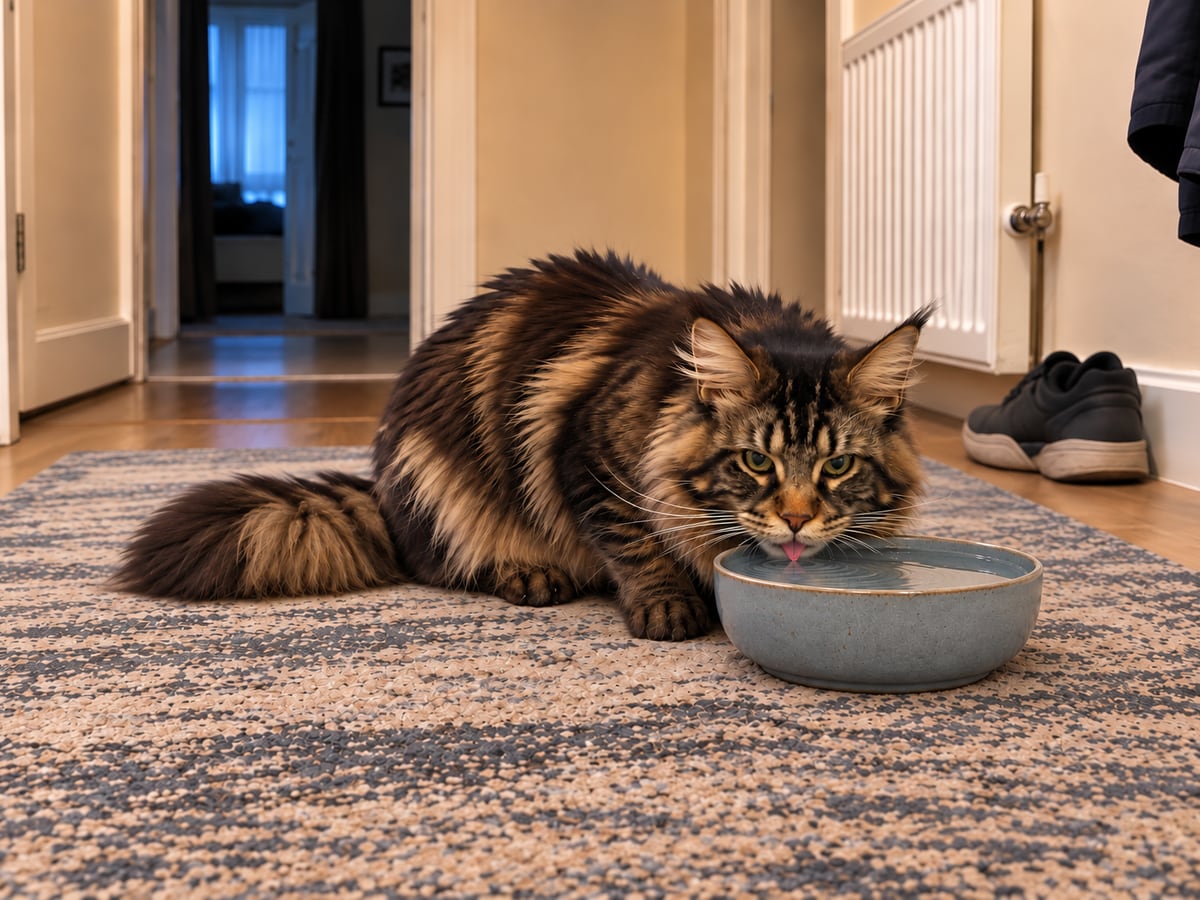
Sometimes it’s the bowl, or where it stands. Cats Protection says cats like to eat, drink and toilet in different places, and that many people put the water bowl right next to the food bowl. Keep water away from both the food and the litter tray, and in a separate room from the tray if you can. International Cat Care adds that your cat will drink more if food and water are in separate places, so skip the double bowls with food on one side and water on the other.
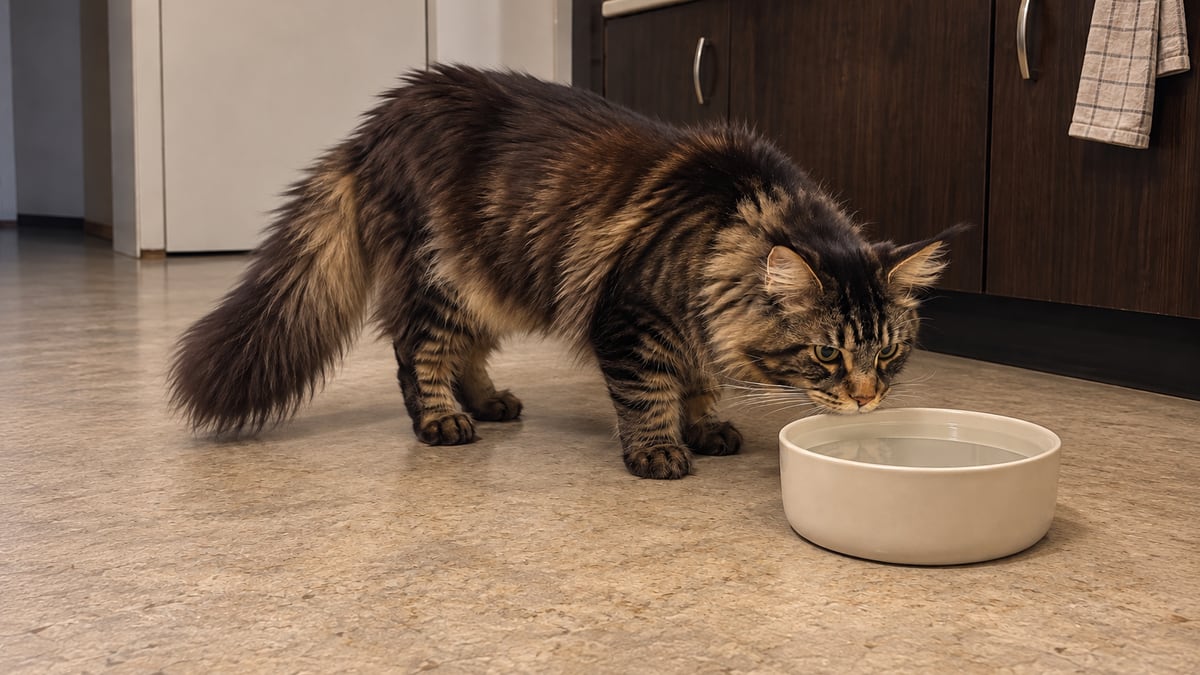
The bowl itself matters too. International Cat Care says most cats prefer a wide, shallow bowl, so they don’t have to put their head inside it, which can make them feel vulnerable. They don’t usually like their whiskers touching the sides either, and in general they prefer glass and ceramic to plastic. Fill it to the brim: cats like to drink from a full container.
Put it somewhere calm. International Cat Care suggests a quiet spot away from busy doors and machines such as the washing machine, and away from walls, so your cat can reach the bowl from all sides. Having their back to the room can make a cat feel vulnerable. Cats Protection suggests leaving room for your cat to sit behind the bowl, so they can see all around them.
Fresh water, every day. Cats Protection compares a bowl that has sat on the floor for a few days to a glass of water you wouldn’t fancy drinking yourself, and suggests refilling it daily.
With more than one cat, look at who gets to the water. Cornell Feline Health Center says a cat can be “banned” from the water bowl by other pets in the house, and International Cat Care advises at least one water bowl per cat, plus one extra.
How to get my cat to drink more water
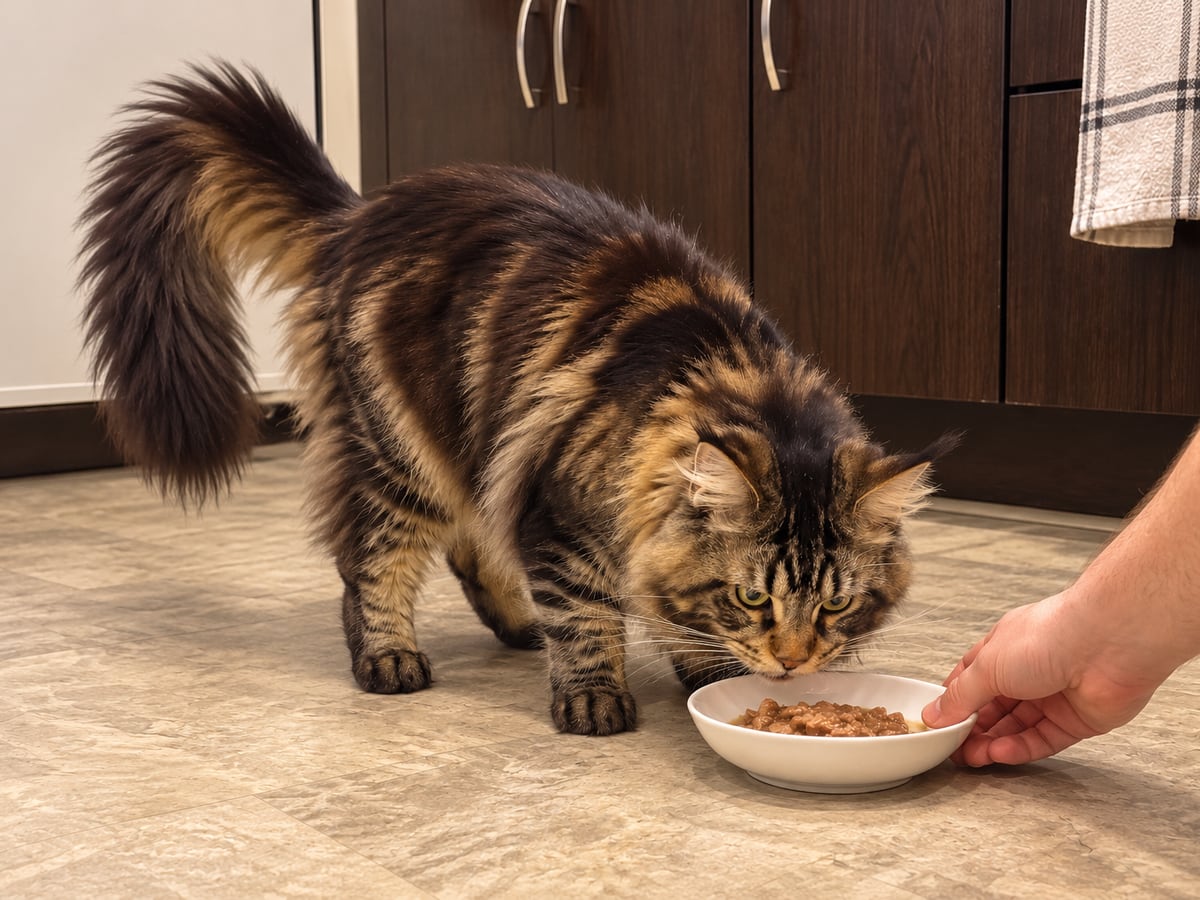
Food is the easiest way in. Cats Protection says wet food contains about 70 to 80% water, so your cat gets a good share of their daily water just from eating. International Cat Care suggests a wet diet rather than a dry one, but check with your vet before changing your cat’s food. Make the switch gradually, Cats Protection says, to lower the chance of an upset stomach.
You can add water to food. International Cat Care says some cats will happily eat wet food that looks like soup, made with water at room temperature rather than cold. Too much water can put a cat off eating and unbalance the diet, so talk it over with your vet team. You can try a little water on dry food as well, but some cats don’t accept the change of texture and may be put off eating.
Try a little flavour. International Cat Care lists the water left from poaching chicken or fish, with no stock or added salt, and the liquid from a can of tuna in spring water. Cornell Feline Health Center mentions a small amount of low-sodium chicken broth. Avoid salty liquids such as brine, stock or gravy, and anything with onion or onion powder, which is poisonous to cats. Skip milk as well: cats can’t fully digest it, and it may cause diarrhoea.
Small things help. Offer water at room temperature, because flavour is reduced in cold liquids, International Cat Care says. Put several bowls around the house, one on each floor, so your cat never has to go far or climb the stairs for a drink. And make changes gradually: cats don’t like sudden changes to their food or water.
Water fountains and the tap
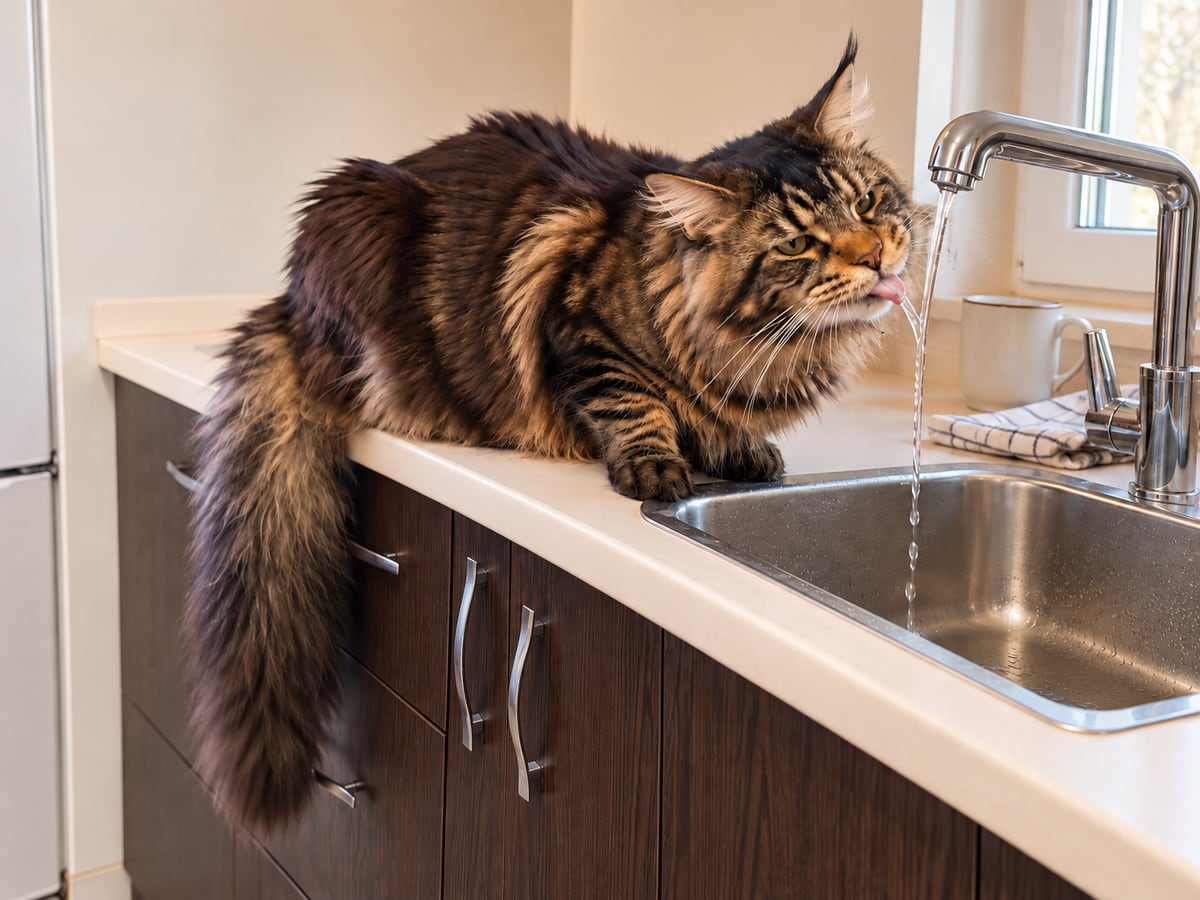
Many cats like the movement and freshness of flowing water, Cats Protection says, which is why yours may try to drink from the tap. International Cat Care suggests a pet water fountain, a dripping tap, or a clean shower tray or bath with a little water in it. Introduce a fountain gradually.
Don’t expect miracles from a fountain, though. In a study from the University of Tennessee’s vet school, published in 2018, 14 healthy laboratory cats on dry food drank about the same on average from a circulating fountain, a free-falling one and a still bowl. Three of the cats did drink more from one type, and each of the three preferred a different one, the still bowl included. Cornell Feline Health Center puts it plainly: some cats drink more with a fountain, but preferences vary.
The authors note that a home, where cats can move freely, might change the picture, and suggest offering more than one type of bowl. So if you buy a fountain, keep the old bowl too, and let your cat choose.
Which cats need more water
For some cats every extra sip counts for more. International Cat Care lists cats with kidney disease, who are more vulnerable to dehydration, cats with idiopathic cystitis or urinary stones, cats with diabetes, and cats taking non-steroidal anti-inflammatory drugs (NSAIDs) and some other medicines.
Age counts too. Cats Protection says mature cats, aged 11 or older, will need to drink plenty of water each day, because their kidneys need a bit of extra help to work properly.
If your cat has one of these conditions, ask your vet how much they should be drinking, and which of the ideas above suit them.
Signs your cat is not drinking enough
Cornell Feline Health Center lists the signs of dehydration as lethargy, weakness, a poor appetite and dry, tacky gums, and in more severe cases, eyes that look sunken into their sockets.
It also describes a check of the skin. Gently lift the skin over the shoulders and let go. In a well-hydrated cat it snaps back almost at once; in a dehydrated cat it may take much longer, or stay “tented”. Older cats can be slow here even when they are well hydrated, so treat it as a reason to call the vet, not as a test to rely on.
Why might a cat drink less? Cornell names weakness or lethargy, a poor appetite, dental problems that make a cat hesitate to drink, no water within reach, and squabbles between cats in the house. If your cat seems to hesitate at the bowl, ask the vet to look at their teeth.
Heat speeds it all up. Cats Protection says cats become dehydrated more quickly on a hot day, and also if they are vomiting or have diarrhoea while not drinking.
When to see a vet
A good appetite buys a little time, but not much. Cats Protection says a cat can survive three to four days without water on average, but will become dehydrated within 24 hours, and dehydration puts stress on the organs.
Cats Protection says to call your vet if your cat doesn’t drink for over 24 hours, has skipped a meal and also not drunk any water, is vomiting or has diarrhoea while not drinking, or is very lethargic or vomiting repeatedly.
Some cats can’t wait that long. Cats Protection says kittens and older cats are more vulnerable to dehydration, and cats with diabetes, kidney disease or an overactive thyroid can go downhill faster if they stop drinking. A kitten who hasn’t drunk for 12 hours should be seen by a vet as soon as possible, and sooner if they are vomiting or have diarrhoea.
If you think your cat is dehydrated, Cornell Feline Health Center says to contact a vet promptly. The vet can give fluids and will look for the reason behind it.
Drinking much more than usual is worth a call too. International Cat Care says to contact your vet team if you think your cat is drinking too much or too little.
New cat not eating or drinking
A new home is a lot to take in. Cats Protection suggests a quiet room with an area for food and a separate one for water, and a litter tray as far from both as possible. If your cat hides for a while, there is no need to worry, it says, as long as they are eating, drinking and using the tray.
The same line applies as for any cat: over 24 hours without a drink, or a missed meal and no water either, means a call to the vet. For a kitten, it’s 12 hours without water. And if your new cat stays stressed for a long time without any signs of getting better, Cats Protection says to contact your vet for advice.
What to write down for the vet
“I never see them drink” gives a vet little to go on, and a number with a date gives a lot. Measure one day with the jug, as above, and note what your cat ate that day, wet or dry, because that changes how much they need to drink from the bowl.
If the change goes the other way, PDSA suggests taking a note of exactly how much your cat drinks in a 24-hour period to the appointment, and a urine sample if you can. Its signs of drinking more include the water bowl emptying quicker than usual, and drinking from places your cat normally doesn’t, such as taps, sinks or the bath.
Add anything else you’ve seen: appetite, vomiting, energy, the litter tray, and the day you changed the food or moved a bowl. Lapka Care is a diary for notes like these, and it puts everything that matters for the vet into one PDF.
What a week of water notes can look like
Monday: 300 ml in the jug at 8 am, two bowls, both next to the food. 260 ml left at 10 pm. Ate two pouches of wet food.
Wednesday: moved one bowl to the hallway, a wide ceramic one, filled to the brim. Drank from it twice while I watched.
Friday: 300 ml in, 235 ml left. Eating as usual, bright, using the tray as normal.
Sunday: the same. No vomiting all week.
The notes show how much left the bowls, what was eaten, and what changed on which day. If the vet asks how much your cat drinks, there’s an answer instead of a guess.
Questions people ask
How long can a cat go without water?
Cats Protection says the average is three to four days, but a cat becomes dehydrated within 24 hours, and faster on a hot day or with vomiting or diarrhoea. Don’t wait it out: call your vet if your cat hasn’t drunk for over 24 hours.
Kitten not drinking water: when should I worry?
Sooner than with an adult cat. Cats Protection says older kittens can only survive for up to 24 hours without water, and a kitten who hasn’t drunk for 12 hours should see a vet as soon as possible, sooner if they are vomiting or have diarrhoea. Its guide for a kitten up to three months, about 1.4 kg, is 70 ml a day.
Why does my cat drink from the tap but not the bowl?
Many cats like the movement and freshness of flowing water, Cats Protection says. Try a fountain, or a wide, full bowl away from the food. If your cat has always done it, it’s a preference. If it’s new and the bowl is emptying faster as well, PDSA counts both among the signs of drinking more than usual, so tell your vet.
Can I give my cat milk instead of water?
No. Cats Protection says milk, cream or any other liquid is no substitute for water, and many cats are lactose intolerant, so milk could make them unwell.
Should the water bowl be next to the food bowl?
Better not. Cats Protection says cats don’t like to drink near where they eat, a habit from their wildcat ancestors, who kept the gut contents of their prey away from their water. International Cat Care says your cat will drink more if food and water are in separate places.
Is it bad if my cat drinks a lot of water?
It can be. PDSA says that if your cat suddenly drinks more than usual, it may be a sign that something is wrong, with causes ranging from a urine infection to kidney disease, diabetes and an overactive thyroid. Take them to your vet with a note of how much they drink, and never take their water away.
Sources
- International Cat Care — How to encourage your cat to drink
- Cornell Feline Health Center — Hydration
- Cats Protection — How much water should a cat drink?
- Cats Protection — 8 tips to get your cat to drink more water
- Cats Protection — How long can cats go without food?
- Cats Protection — Bringing a cat home
- PDSA — Is my cat drinking and weeing too much? (PDF)
- Journal of Feline Medicine and Surgery — Quantified water intake in laboratory cats from still, free-falling and circulating water bowls (Robbins et al., 2018)